
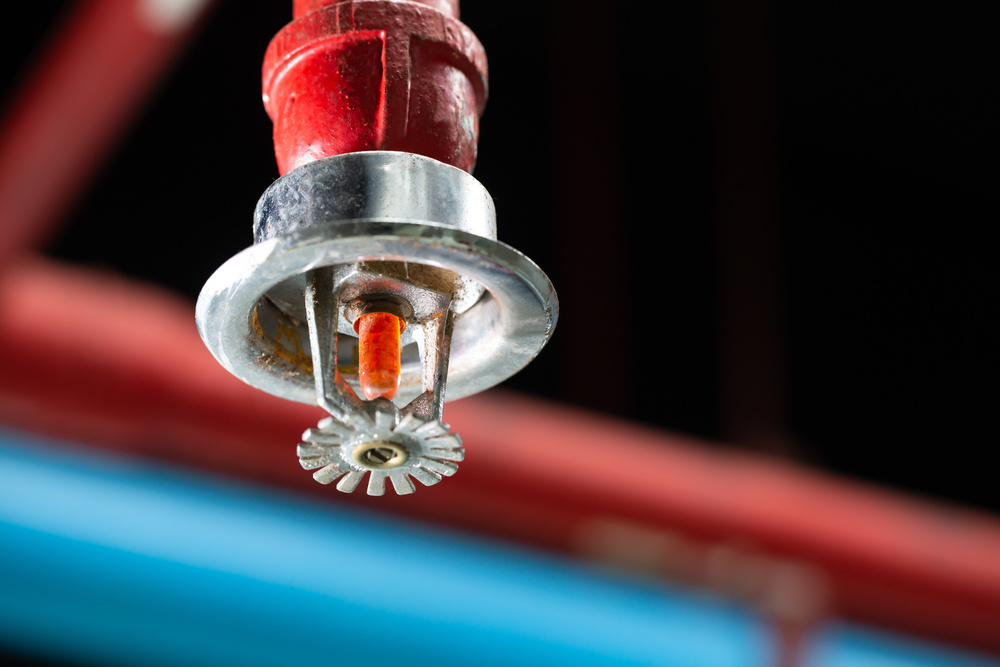
Commercial fire sprinkler systems in Hamilton and throughout Southern Ohio are regulated under NFPA 25 and enforced through the Ohio Fire Code. As a life-safety provider serving commercial facilities across the region, we regularly see how confusion around inspection intervals and impairment procedures creates avoidable compliance gaps.
Understanding how these fire sprinkler inspection requirements apply in real operating environments is essential for staying inspection-ready and avoiding costly citations.
Key Takeaways
- NFPA 25 establishes monthly, quarterly, annual, and five-year inspection and testing requirements for commercial sprinkler systems.
- Local Authorities Having Jurisdiction in Hamilton and Butler County enforce these standards and may require additional documentation.
- Planned and unplanned system impairments require prompt coordination with the AHJ, fire department, and monitoring provider.
- Five-year internal pipe inspections and trip tests often reveal corrosion or obstructions not visible during annual inspections.
- A written inspection, testing, and maintenance calendar reduces compliance risk and operational disruption.
Key Fire Sprinkler Testing Requirements for Southern Ohio Businesses
Understanding the inspection schedule is the foundation of compliance. The inspection, testing, and maintenance framework is established under NFPA 25, which outlines required intervals for water-based fire protection systems.
This layered standard requires year-round attention and coordination with local enforcement under the adopted International Fire Code (IFC).
Monthly Visual Inspections Are a Baseline Requirement
In Hamilton and surrounding Butler County communities, facility managers must ensure control valves and gauges on wet-pipe systems are visually inspected every month. These inspections confirm valves remain fully open and system pressure stays within normal operating ranges.
Monthly checks do not typically require a licensed contractor, but documentation is critical.
During an AHJ audit, missing inspection records often trigger a deeper review. Maintaining written logs demonstrates proactive compliance across all life-safety systems, including those supported through our fire alarm and life safety services.
Quarterly and Semiannual Testing Adds System Verification
Quarterly inspections typically include alarm device checks and verification of fire department connections. For systems connected to a central monitoring station, waterflow alarm and supervisory signal tests are generally required every quarter.
Semiannual testing may apply to dry-pipe components and certain valve assemblies. Businesses that rely solely on an annual contractor visit often overlook these required intervals. Inspection frequencies must be assigned to each component type rather than treated as a single annual event.
Annual and Five-Year Inspections Address System Integrity
The annual inspection is the most comprehensive review in the NFPA 25 cycle. It includes sprinkler head condition checks, main drain testing, forward-flow testing, and evaluation of pipe supports and hangers. In Ohio, the annual inspection report is typically reviewed by the local fire marshal or the Ohio State Fire Marshal’s office, depending on occupancy classification.
Every five years, NFPA 25 requires an internal inspection of sprinkler piping. In older commercial buildings throughout Southern Ohio, this process often identifies corrosion, scale buildup, or microbiologically influenced corrosion that is not visible externally. Dry-pipe and pre-action systems also require a full trip test during the five-year cycle to verify valve performance.
Planning for Compliance and Managing Impairments
Compliance involves more than completing scheduled inspections. It requires documentation, coordination, and clearly assigned responsibility across the facilities we support throughout our service areas in Southwest Ohio and Northern Kentucky.
Create a Written ITM Calendar for Each Building
A structured inspection, testing, and maintenance calendar should list each system component and its required frequency. Facilities with multiple buildings in Hamilton or the Greater Cincinnati region should organize schedules by structure and system zone.
Posting a master schedule in the mechanical room keeps facility staff and contractors aligned. It also supports continuity during staff turnover or management transitions.
Designate an Impairment Coordinator Before It Is Needed
NFPA 25 requires facilities to appoint an impairment coordinator responsible for managing system shutdowns. This individual must handle notifications to the AHJ, local fire department, and monitoring provider. The coordinator must also implement fire-watch procedures when required.
Waiting until an emergency shutdown occurs often leads to delayed notifications and potential code violations. Establishing this role in advance supports a controlled and compliant response.
Coordinate Planned and Emergency Impairments Properly
Planned impairments require advance notice to the local AHJ and fire department. In Hamilton, this typically means contacting the Hamilton Division of Fire before any portion of the sprinkler system is taken offline.
Unplanned impairments require immediate notification and corrective action. Maintaining updated contact information for contractors, monitoring providers, and local authorities streamlines response and reduces compliance exposure.
Schedule Your Inspection With R.P. Biederman Company
Fire protection compliance in Southern Ohio requires coordination, documentation, and technical expertise. Since 1967, R.P. Biederman Company has supported commercial facilities throughout Hamilton, Greater Cincinnati, Dayton, and Northern Kentucky with life-safety system expertise.
If your facility is approaching an annual inspection, preparing for a five-year internal review, or managing a system impairment, our team can help you build a structured inspection and testing plan. Contact us to schedule a consultation with a specialist.
Frequently Asked Questions
How often must sprinkler systems be inspected in Ohio?
Monthly valve checks, quarterly alarm tests, annual inspections, and five-year internal pipe inspections are required under NFPA 25 for most commercial occupancies.
Who enforces sprinkler inspection requirements in Hamilton?
The local Authority Having Jurisdiction, typically the municipal fire department or fire marshal, enforces compliance with NFPA 25 and the Ohio Fire Code.
What is a five-year sprinkler inspection?
A five-year inspection includes internal pipe examination and, for dry-pipe systems, a full trip test to confirm proper valve operation and water delivery.
Can facility staff perform monthly inspections?
Yes. Trained facility staff may complete monthly visual inspections of valves and gauges, but annual and five-year testing must be performed by qualified professionals.